
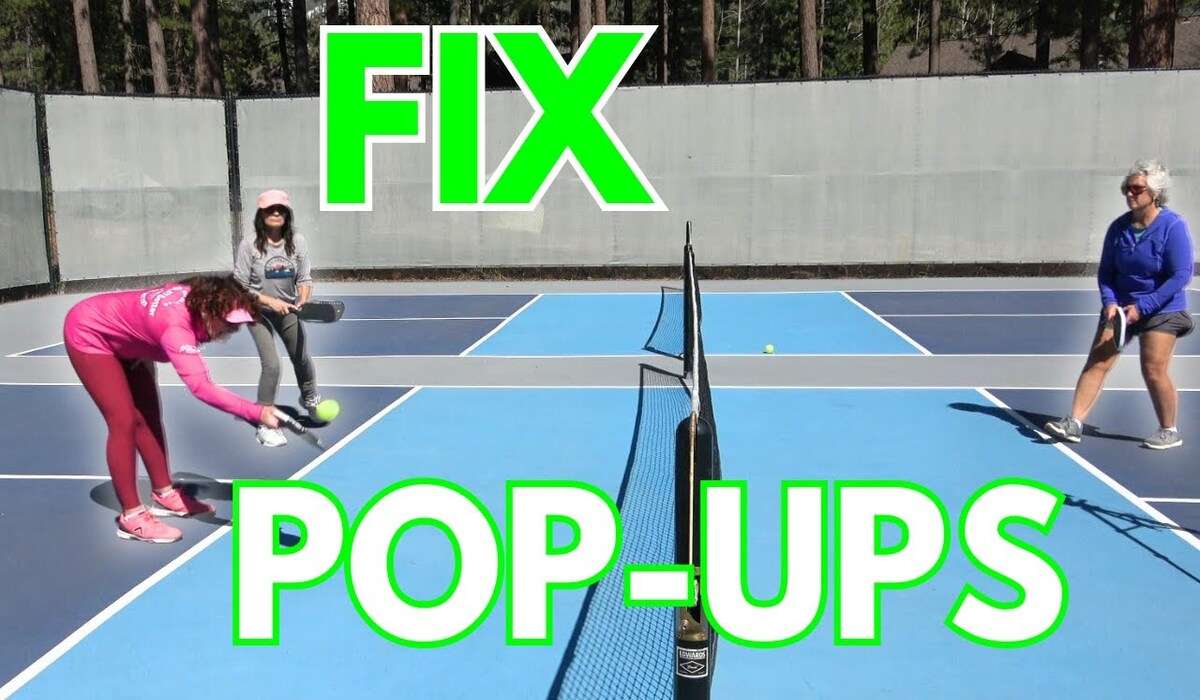
Are you getting your partner in trouble on the pickleball court with these dink mistakes?
If you’re popping up your dinks, it could lead to your partner getting “smoked” by the opponents. But we can fix that!
In this post, I’ll show you six of the most common dink mistakes I see on the court—and how to fix them quickly so you can control the kitchen and win more points.
Dink Mistake #1: Narrow Stance and Poor Knee Bend
Too many players stand at the kitchen line with their feet too close together and little to no knee bend.
When they try to dink, they bend forward from the waist—losing balance and control. This makes it easy to pop the ball up and hard to recover.
What to do instead:
Widen your stance—feet slightly more than shoulder-width apart. Instead of bending from your hips, bend your knees to get underneath the ball.
This posture gives you better balance, mobility, and control when you lift the shot over the net.
Mistake #2: Incorrect Grip Pressure
If you’re holding your paddle like a hammer, it’s no wonder your dinks are flying. Grip pressure is one of the most overlooked elements of control.
What to do instead:
Use a lighter grip. Think of it on a scale from 1 to 10—1 being feather-light, 10 being a death grip. Your dink grip should land around a 2 or 3.
A lighter grip allows for better feel and control over the paddle face, especially on delicate shots like dinks.
Mistake #3: Oversized Backswing
Big swings and soft shots don’t mix. A common mistake is taking a long backswing before the dink, adding too much energy and leading to unintentional pop-ups.
What to do instead:
Keep your swing compact. Take the paddle directly to where the ball will be, and use a short, controlled lift over the net. The smaller the motion, the more consistent and controlled your dink will be.
Mistake #4: Using Too Much Wrist
The wrist is a small joint, and relying on it too much during your dink introduces instability and inconsistency. Sometimes the ball goes perfectly; other times it flies high—and suddenly, you’re in trouble.
What to do instead:
Let the motion come from your shoulder. Keep your wrist soft but passive. The shoulder provides a more stable, repeatable motion.
Think of your wrist as along for the ride—not the driver of the shot.
Mistake #5: Reaching and Leaning Instead of Moving
Do you find yourself reaching sideways and leaning to hit dinks? That’s a recipe for off-balance shots and poor paddle position. At camp, we like to say: “Don’t be Eileen” (I lean)—move your feet!
What to do instead:
Stay light on your feet and on the balls—or triangles—of your feet. Move your body to the ball instead of leaning.
This gives you the control to hit with better form and consistency, especially on wide dinks.
Mistake #6: Taking the Ball Before the Apex
Timing matters. Many players take the ball too early—right after the bounce—which is harder to control because the ball still has energy. This is known as the short hop.
What to do instead:
Wait for the apex of the bounce—the highest point after the ball hits the ground. That’s when it has the least energy and is easiest to manage.
Let the ball rise, get into position, and then make your shot. Yes, it may take a little more footwork, but it will dramatically reduce your pop-ups.
Which Mistake Are You Making?
Even fixing just one of these six issues can dramatically reduce how often you pop up your dinks. More importantly, it gives you confidence at the kitchen line and makes you a more reliable partner.
Want to keep improving?
👉 Download the free Prepare to Play Guide to help you mentally warm up and bring your best self to the court.
And if you haven’t yet, watch the full video above for demonstrations of each fix in action.
Let’s train smart, live bold, and age well.
—CJ Johnson, Better Pickleball

CJ Johnson
Hey there — I’m a professional three-sport athlete and coach who has spent my entire adult life earning a living from playing and coaching sports. Since I started coaching more than three decades ago, one thing has remained the same: My commitment to see students not as they are but as what they can become and to move heaven and earth to help them realize their untapped potential. You should know that when it comes to helping pickleball players over 50 live their best lives on and off the courts, I'm an expert. Good pickleball is not just technique; it's the mind and body working holistically. That's why I'm also a personal trainer and weight management specialist. When I’m chillin', you'll find me watching Star Trek with my husband John and our two fur babies, Shirley and Ralph. (Yes, Happy Days)